Most people see the finished stained concrete.
They see the color, the movement in the floor, the way the sealer brings everything together, and how much better the space looks when the job is done.
What they usually don’t see is what goes into getting there.
A good concrete staining job isn’t about showing up with a bucket of stain and making the slab darker. The condition of the concrete, the application, and the final sealer all play a part.
Here’s what a professional concrete staining process looks like from start to finish.
Before we talk about colors or finishes, we want to see the slab.
Not every piece of concrete is the same.
An older patio may have years of dirt and previous sealers on it. A garage might have oil contamination. An interior floor could have adhesive left behind from old tile or carpet. A driveway may have repairs, cracks, or areas that weathered differently.
The first step is figuring out what we’re working with.
We’re looking at things like:
Sometimes the slab is a great candidate for staining.
Sometimes it needs some work first.
And sometimes we’ll tell somebody another finish makes more sense.
That conversation should happen before the project starts, not halfway through it.
Concrete needs to be able to accept the stain properly.
Old sealer, oil, adhesive, paint, grease, and other contaminants can interfere with the finished result. Depending on the slab, professional concrete prep in San Antonio may involve cleaning, grinding, stripping an older coating, or a combination of methods.
There isn’t one process that makes sense for every floor.
The goal is simply to get the concrete into the right condition for the finish we’re putting on it.
It’s not the exciting part of the project, but it matters.
Concrete cracks.
That’s just part of owning concrete in Texas.
Before staining, we look at cracks and damaged areas and determine what needs attention.
Some cracks are mostly cosmetic. Others may need repair. Older slabs may also have patches or previous repairs that will remain visible after staining.
This is important because stain doesn’t hide everything.
And we don’t necessarily want it to.
One of the reasons stained concrete looks so good is because it keeps some of the natural character of the slab.
Variations, movement, and even some imperfections may become part of the finished floor.
A good contractor should explain that before the job begins so you know what to expect.
Once we understand the slab, we can start talking seriously about the finished appearance.
This is usually the part homeowners have the most fun with.
You can go darker, lighter, warmer, more natural, more modern, or somewhere in between.
But stained concrete isn’t paint.
You’re not choosing an exact color off a card and expecting every square inch of the floor to look identical.
Concrete has its own personality.
Porosity, age, previous use, repairs, and natural variation can all affect how the stain looks.
That’s a good thing.
It’s what gives stained concrete depth and keeps the finished surface from looking manufactured.
If somebody wants a floor where every square inch is exactly the same color, stain probably isn’t the right product.
If you want something with movement and character, that’s where stained concrete does its best work.
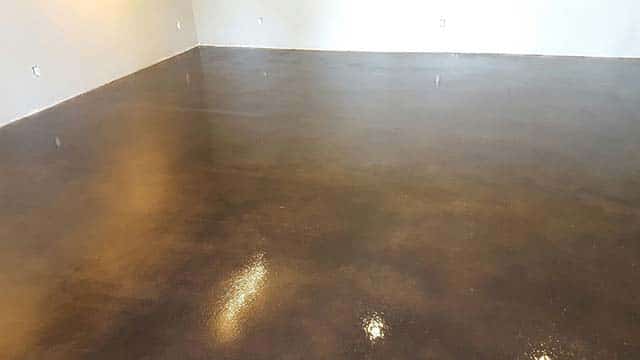
Once the surface is ready, we move into the actual staining process.
The exact application depends on the type of stain, the concrete, and the look we’re trying to achieve.
This is where experience makes a difference.
The goal isn’t just to put color on the floor. We’re watching how the concrete accepts the stain and how the overall appearance develops.
Different areas of the same slab can react differently.
That’s normal.
Knowing how to work with those variations is part of the job.
This is why staining concrete isn’t the same as painting a wall. Concrete isn’t perfectly predictable, and trying to force it to look perfectly uniform usually defeats the reason you chose stain in the first place.
Concrete staining isn’t something we rush.
Depending on the system, the stain needs time to work and the surface needs to be ready before we move to the next stage.
There may also be cleaning required before the sealer goes down.
The exact process varies from job to job, but the basic idea is simple: one stage needs to be right before we move on to the next one.
Cutting corners to save a little time doesn’t make much sense if it hurts the finished result.
Once we’re happy with the stained surface, it’s time to protect it.
The sealer is a big part of the finished floor.
It helps protect the concrete from dirt, moisture, spills, traffic, and normal wear. It also brings out the color and affects the final appearance.
An indoor floor doesn’t have the same needs as a driveway.
A covered patio doesn’t live the same life as a pool deck sitting in the San Antonio sun.
We choose the sealing system based on where the concrete is located and how it will be used.
That matters here in South Texas, where exterior concrete has to deal with plenty of sun, heat, rain, and dirt.
People tend to spend a lot of time thinking about stain colors and not nearly as much time thinking about the protective finish.
The sealer can affect:
More sealer isn’t automatically better, either.
The goal is the right finish for the surface and the way it’s going to be used.
Once the project is complete, stained concrete is pretty easy to live with.
Keep it clean.
Don’t attack it with harsh chemicals.
Clean spills when they happen.
And pay attention to the condition of the sealer over time.
That’s about it.
Interior floors usually have an easier life than exterior concrete. Patios, driveways, pool decks, garages, and commercial spaces may need attention sooner because they see more traffic and weather.
The good news is that you’re maintaining the protective finish. You’re not starting the entire staining process over every few years.
When the job is done correctly from the beginning, stained concrete is a very manageable surface to own.
You should expect somebody to ask questions.
That’s how we approach projects at Stain Concepts.
We’d rather give you the right answer before the job starts than explain a problem after it’s finished.
If you’re considering stained concrete for a floor, patio, garage, driveway, pool area, or commercial space, the first step isn’t picking a color.
It’s figuring out what you’re working with and what kind of finish makes sense for the space.
At Stain Concepts, we can take a look at the concrete, talk through the options, and explain what the project would involve.
If you’ve been researching the concrete staining process in San Antonio and want to know what your property would actually require, CONTACT US TODAY.
We’ll look at what you’ve got and give you a straight answer.
It depends on the condition of the slab, the size of the area, the stain system being used, and how much prep is needed. Some jobs move quickly, while others take longer because the concrete needs more work before staining begins.
Because the stain has to work with the concrete itself. Old coatings, grease, paint, adhesive, and other contaminants can interfere with the way the stain takes. Good prep helps create a more consistent and durable result.
Yes, in many cases. Cracks and repairs should be evaluated first, and some may need attention before staining. Keep in mind that stain does not hide every imperfection, so some variation may remain visible.
No, and that is part of the appeal. Concrete has natural variation, and different areas can absorb or react to stain differently. The finished floor should have character and movement rather than looking perfectly uniform.
Sealer is applied after the staining stage is complete and the surface is ready. It helps protect the concrete and also affects the final sheen, color depth, and ease of maintenance.
That depends on the stain and sealer system. The surface needs enough time to cure before it sees normal foot traffic, furniture, or vehicles. Your contractor should give you specific timing for your project.
For most homeowners, yes. The biggest challenge is usually not applying the stain. It is evaluating the slab, preparing it correctly, dealing with repairs or old coatings, and choosing the right sealer for the space.
Alamo Heights | Alamo Ranch | Austin | Bandera | Blanco | Boerne | Bulverde | Canyon Lake | Castle Hills | Castroville | Cibolo | Comfort | Corpus Christi | Devine | Driftwood | Dripping Springs | The Dominion | Fair Oaks Ranch | Floresville | Fredericksburg | Helotes | Hondo | Johnson City | Kerrville | Leon Springs | Leon Valley | Marble Falls | Natalia | New Braunfels | Pipe Creek | San Antonio | San Marcos | Seguin | Shavano Park | Spring Branch | Stone Oak
Copyright © 2026 Stain Concepts | All Rights Reserved | Website Design by Strottner Designs, LLC